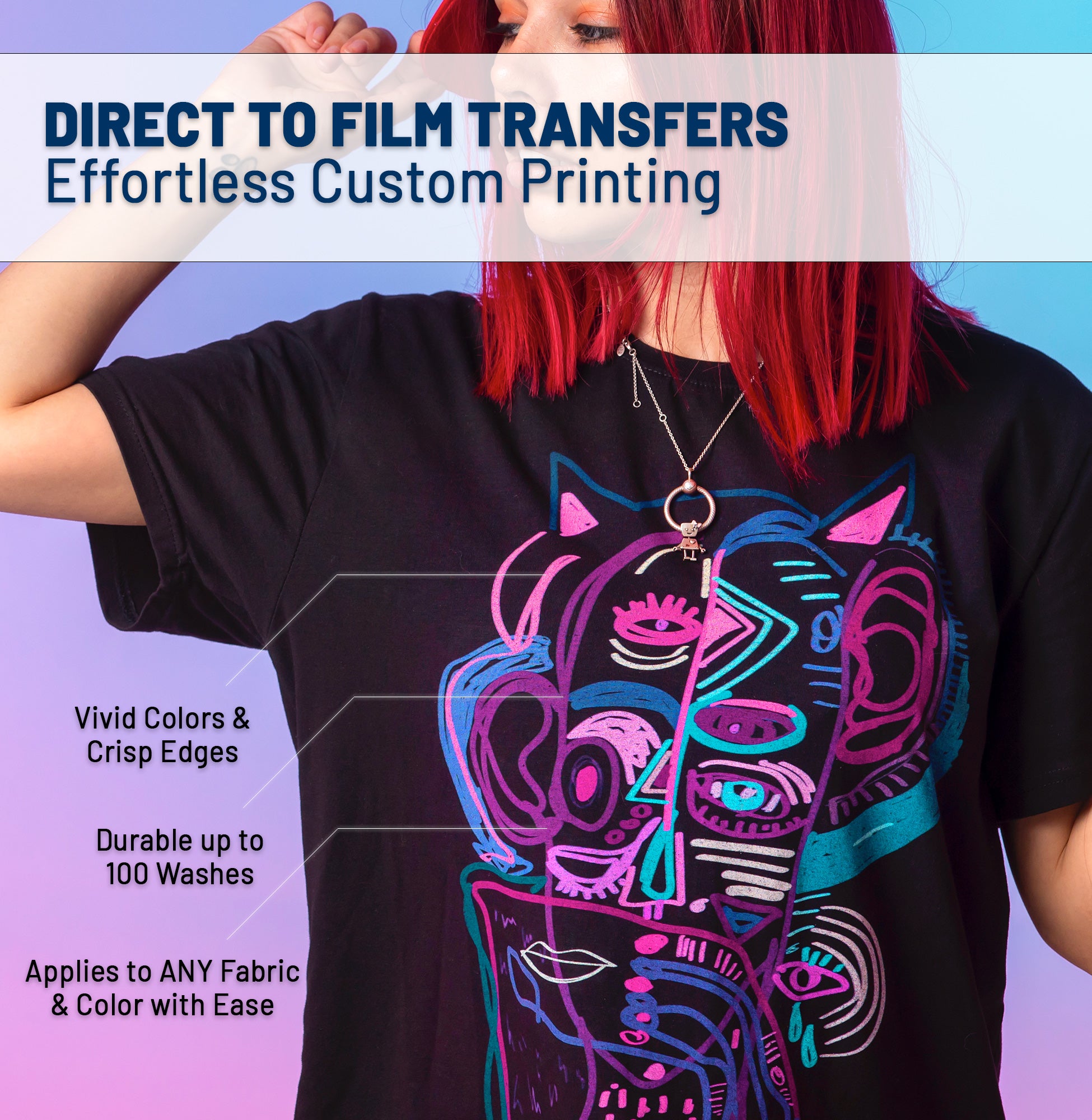




If you've been exploring custom printing options, you've likely stumbled upon two similar-sounding technologies: DTF (Direct-to-Film) and UV DTF. While the names suggest a close relationship, these are fundamentally different products designed for completely different applications. Choosing the wrong one can lead to peeling prints, wasted materials, and frustrated customers.
⚡ Quick Answer: Which Do I Need?
🎨 Choose DTF If...
- Printing on fabric/textiles
- Need 50+ wash durability
- Creating t-shirts, hoodies, bags
- Require soft, flexible feel
✨ Choose UV DTF If...
- Decorating hard surfaces
- Making tumblers, mugs, phone cases
- Creating labels, decals, stickers
- Need no heat press application
🔬 What is DTF (Direct-to-Film)?
DTF, or Direct-to-Film, is a textile decoration method where designs are printed onto a special PET film using CMYK + White inks, coated with a heat-activated adhesive powder, and then heat-pressed onto fabric. The result is a vibrant, durable print that becomes part of the garment.
DTF Key Characteristics
- Requires heat press (300-315°F / 150-157°C)
- Works on almost any fabric - cotton, polyester, blends, nylon, leather
- Uses TPU adhesive powder - melts and bonds with fabric fibers
- Washable - survives 50+ laundry cycles when applied correctly
- Soft, flexible finish - moves with the fabric
✨ What is UV DTF?
UV DTF uses UV-cured inks printed onto a special two-layer film (carrier layer + adhesive layer). The design cures instantly under UV light and can be cold-applied (no heat required) to hard, smooth surfaces by simply peeling and pressing.
UV DTF Key Characteristics
- No heat required - peel and stick application
- Works on hard, smooth surfaces - glass, metal, plastic, wood, acrylic
- Uses UV-cured inks - instant drying, scratch-resistant coating
- Not washable in machines - surface wipe only
- Raised, glossy texture - has a sticker-like 3D feel
📊 Head-to-Head Comparison
| Feature | DTF | UV DTF |
|---|---|---|
| Primary Use | Fabric & Textiles | Hard Surfaces |
| Application Method | Heat Press (300°F+) | Peel & Stick (Cold) |
| Equipment Needed | Heat Press Required | None (Squeegee helps) |
| Durability | 50+ Washes | Indoor: Years | Outdoor: 6-12 mo. |
| Flexibility | Flexible (Moves with fabric) | Rigid (Sticker-like) |
| Texture | Soft, Matte/Satin | Raised, Glossy |
| Best For | T-shirts, Hoodies, Bags, Hats | Tumblers, Mugs, Laptops, Signage |
| Machine Washable? | ✅ Yes | ❌ No (Hand wipe only) |
| Can Use on Fabric? | ✅ Yes | ❌ No (Will peel off) |
🎯 Use Cases: When to Use Which
⚠️ Common Mistakes to Avoid
Using UV DTF on T-shirts
UV DTF is not designed for fabric. It will peel off after one wear or wash. Always use regular DTF for textiles.
Heat Pressing UV DTF
UV DTF transfers are cold-apply only. Heat will melt and destroy the transfer.
Putting UV DTF Items in Dishwasher
UV DTF is not designed for prolonged water exposure. Hand wash/wipe only for drinkware.
Applying UV DTF to Textured Surfaces
UV DTF needs a smooth, flat surface to adhere properly. Rough or porous surfaces won't work.
💡 Pro Tips for Each Technology
DTF Pro Tips
- Always pre-press fabric to remove moisture
- Use heavy pressure (60 PSI)
- Do the second press for durability
- Store transfers flat, away from heat/humidity
- Use gang sheets to maximize cost efficiency
UV DTF Pro Tips
- Clean surface with alcohol before applying
- Use a squeegee to remove air bubbles
- Start from one edge and work across slowly
- Apply clear coat spray for outdoor durability
- Use on curved surfaces like tumblers with a heat gun to make film pliable
💰 Cost Comparison
Both technologies have different cost structures based on your business model:
Startup Costs
| Item | DTF | UV DTF |
| Quality Heat Press | $200-500 | Not needed |
| Blank Garments/Products | $3-15 each | $1-10 each |
| Transfers (from supplier) | ~$0.05-0.10/sq in | ~$0.50-2.00/sheet |
Bottom Line: DTF has a higher initial investment (heat press) but lower per-unit transfer costs at scale. UV DTF has almost zero startup cost but is typically more expensive per design.
🏆 Verdict: Which Should You Choose?
The Final Word
DTF and UV DTF are not competitors—they're companions. Smart businesses use DTF for all fabric-based products (t-shirts, hoodies, bags) and UV DTF for hard goods (tumblers, mugs, signage). Together, they allow you to offer a complete custom product lineup without expensive equipment for every decoration method.
Ready to expand your product offerings? Explore our DTF Gang Sheet Builder for apparel projects, or check out our UV DTF Sticker Collection for hard surface decoration.
New to DTF? Start with our Free Sample Pack to feel the quality firsthand.
This guide is part of the Sky Print Academy — your free resource for mastering custom printing technologies. Have questions? Drop a comment below or reach out to our team!