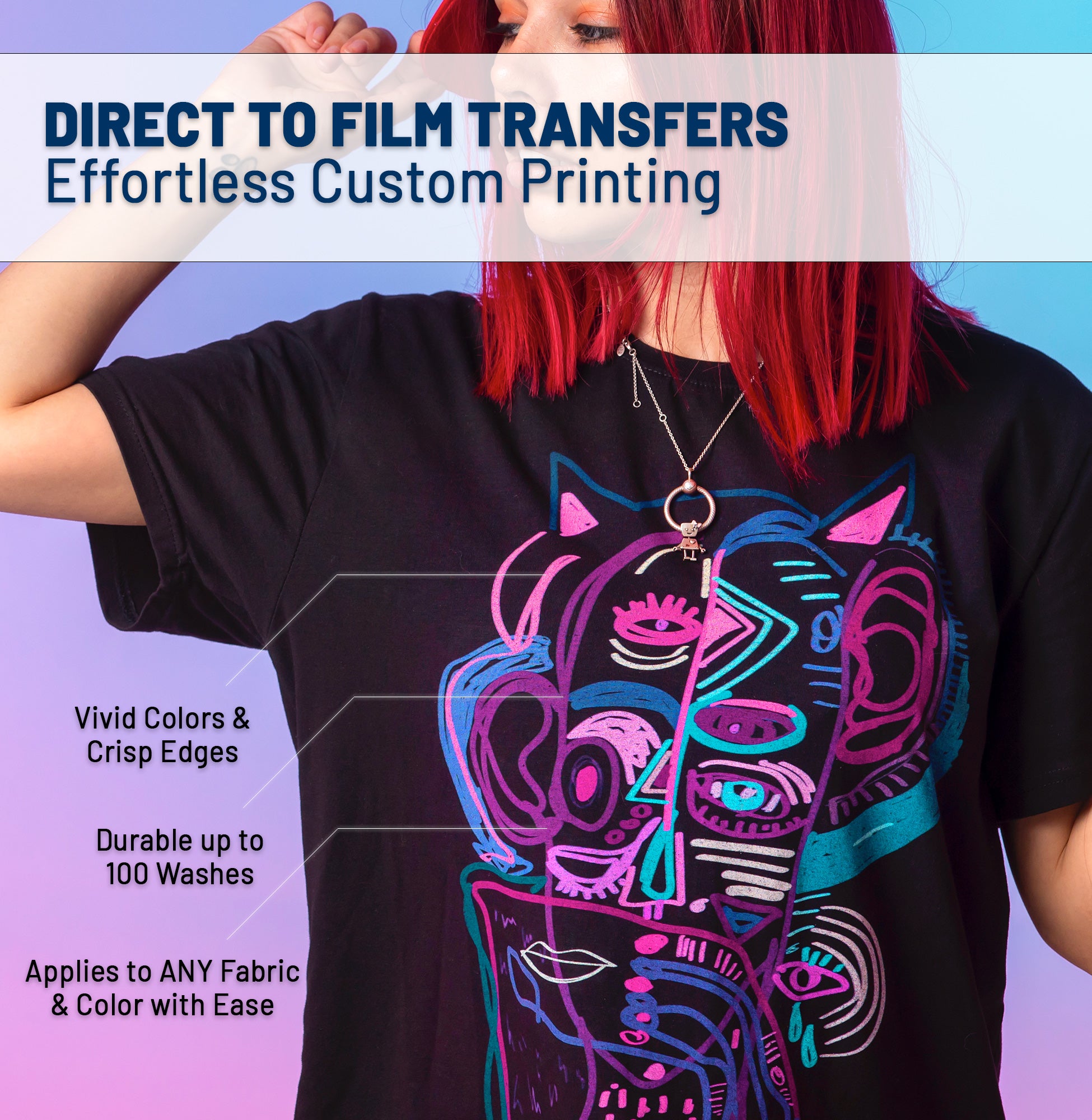




For decades, screen printing was the undisputed gold standard of t-shirt decoration. If you wanted durability and quality, you screened it. But in the last few years, a challenger has emerged that is changing everything: Direct-to-Film (DTF). The question we get asked most often at Sky Print House is, "Which one is better?" The answer depends entirely on what you're trying to achieve. Let's settle this once and for all.
🥊 The Showdown: How They Work
Screen Printing
The traditional method involving creating a mesh stencil (screen) for each color in your design. Ink is pushed through the screen onto the fabric, then cured. It requires messy setups, chemical exposure, and separating colors manually.
DTF Printing
A digital method where designs are printed onto a specialized PET film using water-based inks, then coated with a powdered adhesive. The film is heat-pressed onto the garment. It handles unlimited colors in a single pass.
📊 Comparison Chart
| Feature | Screen Printing | DTF (Direct-to-Film) |
|---|---|---|
| Setup Cost | High (Screen fees per color) | Virtual Zero |
| Minimum Order | Usually 24-50 pieces | 1 item |
| Color Limit | Limited (More colors = more $$) | Unlimited (CMYK + White) |
| Detail/Resolution | Good, but struggles with fine gradients | Photorealistic |
| Feel (Hand) | Softer (especially discharge ink) | Slight plastic feel (improving daily) |
| Durability | Excellent (Lasts lifetime of shirt) | Great (50-60+ washes if applied correctly) |
🏆 When to Choose Which?
Choose Screen Printing IF:
- ✅ You are ordering 500+ shirts with the exact same design.
- ✅ Your design has only 1 or 2 spot colors.
- ✅ You need specific Pantone matching (though DTF is getting very close).
- ✅ You want a "vintage" look where the print fades with the shirt.
Choose DTF Printing IF:
- ✅ You are a small brand or startup ordering small batches (10-100 units).
- ✅ Your design has gradients, shadows, or photographs.
- ✅ You want to print on difficult fabrics like nylon, polyester, or fleece.
- ✅ You want to hold inventory of transfers, not finished shirts.
- ✅ You need variable data (e.g., custom names/numbers for jersey).
🧪 The Durability Myth
Old-school printers love to say, "DTF peels off." And that was true... in 2020. Today, with high-quality TPU powders and industrial curing ovens (like we use at Sky Print House), a DTF print effectively fuses into the fabric fibers.
We've stress-tested our transfers through 60+ hot wash cycles. The result? The cotton shirt fabric usually degrades before the print does.
Because DTF sits slightly on top of the fabric (rather than soaking in like water-based screen print), colors remain vibrant even on dark garments without needing a thick, cracking underbase.
🏁 Conclusion
Screen printing isn't dead, but for the modern e-commerce entrepreneur, DTF is the clear winner. It offers the flexibility, speed, and quality needed to compete in a fast-paced market.
Ready to see the difference yourself? Order a free sample pack and feel the revolution.